-
Continue reading →: Terraform – Introduction: Installation
In this blog post I am going to introduce Terraform and install it. What’s Terraform? Terraform is a tool to help build infrastructure from code, i.e. it takes a terraform file and then creates / destroys infrastructure as required. Terraform was created by Hashicorp, the same company behind Vagrant and…
-
 Continue reading →: AWS – Virtual Image To EC2 Image (AWS)
In this blog post I am going to look at exporting a virtual machine from Virtual Box and then importing it into AWS for use as an EC2 instance. Note: During my initial test I used a version of Ubuntu not yet supported by AWS EC2 (well, a version of the…
-
 Continue reading →: AWS – Using Logstash to Ingest Logs From S3 Bucket Into Elastic
I have written a few blog posts about setting up an ELK (Elastic Logstash Kibana) stack but have not really touched on the power of Logstash. In this blog post I am hoping to resolve this by looking at using Logstash to get logs from an AWS S3 bucket and…
-
 Continue reading →: Changing Ansible Playbook Depending On Operating System (Ansible)
When running an Ansible playbook (or roles) it becomes a little bit irksome to have to create new playbooks just because a device may have a different operating system. Thankfully the awesome people behind Ansible have a solution for this. A Little Background… I have my inventory set in a…
-
 Continue reading →: Using Ansible with AWS – Creating Multiple EC2 Instances, Tagging Them and ELK (AWS/Ansible)
In my previous blog post I used Ansible to create an AWS EC2 instance and discussed how to do this via the Ansible ec2 module. Today I am going to go slightly more in depth with creating multiple instances, inventory groups and tagging. The playbook I am using for this…
-
 Continue reading →: Using Ansible With AWS – Creating EC2 Instances (AWS / Ansible)
So far most of my Ansible blog posts have been deploying or configuring local devices (i.e. normally one of my Raspberry Pis), but the whole idea of Ansible is that it can build whole infrastructures as code (well, YAML files in my incase). The best place to see infrastructure as…
-
 Continue reading →: Caching Requests (Python)
Python’s Requests module is a great way for interacting with data over the internet, however when designing/building a Python program that uses Requests that can mean lots (and lots) of Request calls to test a function. This is not too great if you are testing over a poor internet connection,…
-
Continue reading →: Installing Go Compiler On Raspberry Pi 4 (Raspberry Pi OS 32-Bit)
Go (Golang) requires a compiler to build it’s code and it only takes a few lines to install that compiler on the Raspberry Pi. I’m using a Raspberry Pi 4 with Raspberry Pi OS (32-bit). Download the appropriate binary release The binaries are available from https://golang.org/dl/ . The Raspberry Pi…
-
 Continue reading →: Grafana, Prometheus and Node Exporter On Raspberry Pi via Ansible (Raspberry Pi and Linux)
If you want to see metrics in real time and look at web dashboards then Grafana and Prometheus may be the tools you are looking for, and if you are anything like me then you probably want to automate as much of the install as possible via Ansible. My Set…
-
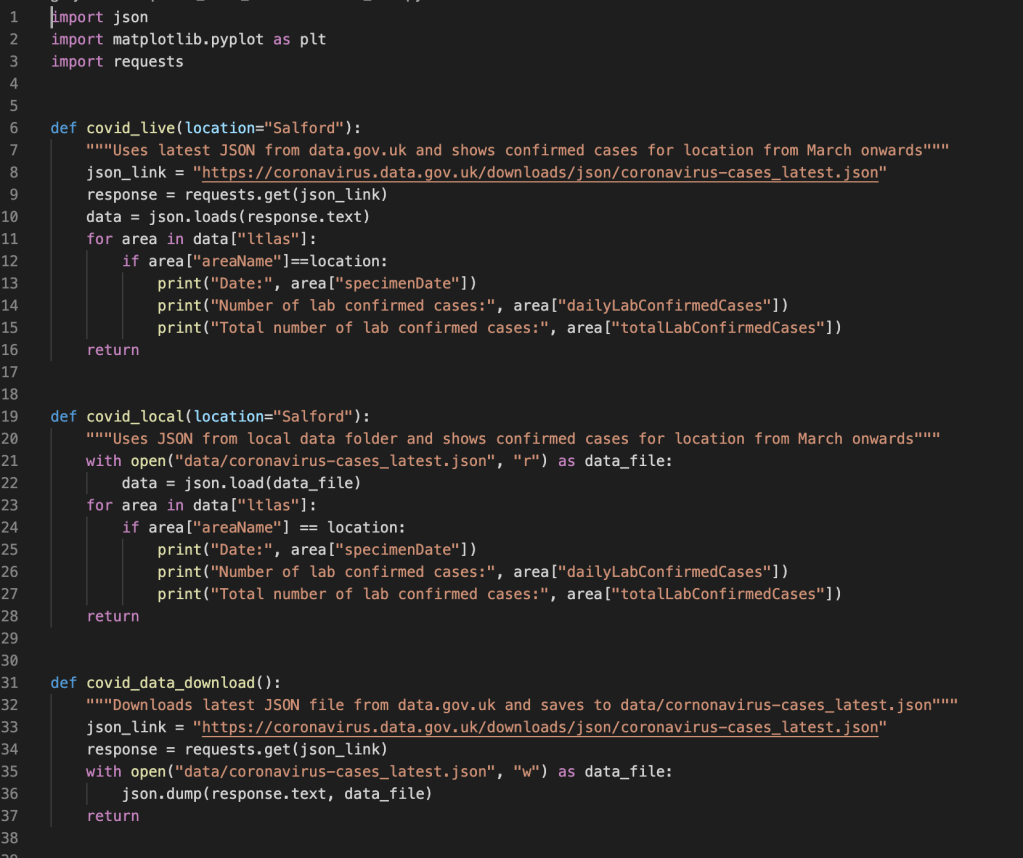 Continue reading →: UK Covid-19 / Coronavirus Data (Python)
The UK recently lowered the alert level for Covid-19 / Coronavirus pandemic, with the UK at level 3 (at time of writing this blog, 24th June 2020) and there has been discussion in the media about R levels differing at local levels and of the possibility of local lock downs.…
Hello,
Welcome to GeekTechStuff

My home away from home and where I will be sharing my adventures in the world of technology and all things geek.
The technology subjects have varied over the years from Python code to handle ciphers and Pig Latin, to IoT sensors in Azure and Python handling Bluetooth, to Ansible and Terraform and material around DevOps.
Let’s connect
Join the fun!
Stay updated with the sites latest blog posts by joining the newsletter.

 GeekTechStuff